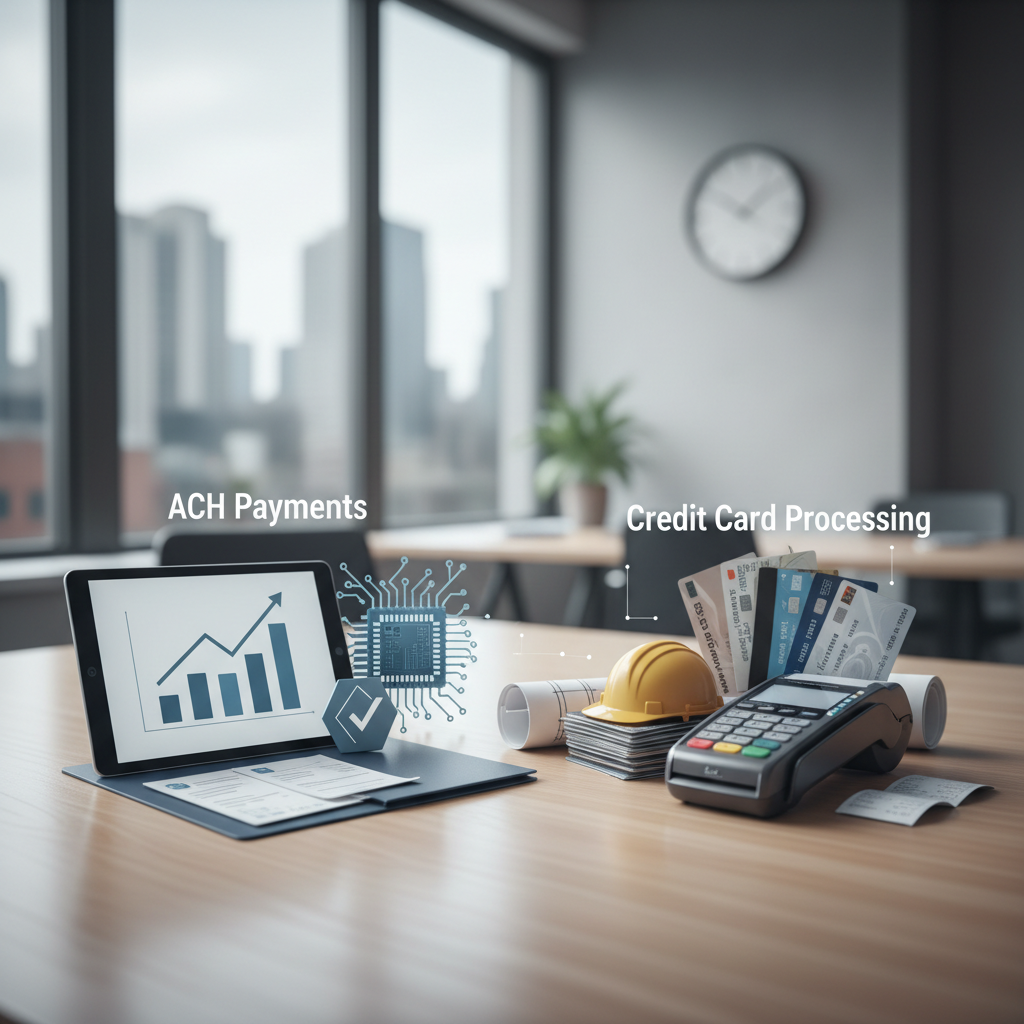
ACH vs. Credit Card: Choosing the Best Payment Methods for Your Construction Business
ACH vs. Credit Card: Choosing the Best Payment Methods for Your Construction Business
As a hands-on contractor in Folsom, CA, managing cash flow is paramount. Every decision, from material sourcing to payment collection, directly impacts your bottom line. In today's digital landscape, offering diverse electronic payment options is no longer a luxury but a necessity. Yet, navigating the world of ACH payments and credit card processing can feel like another job in itself. Which one is better for your construction business? Which offers the best balance of convenience, speed, and cost-effectiveness?
This article will delve deep into the mechanics, benefits, and drawbacks of both ACH and credit card payments, providing you with the insights needed to make informed decisions that optimize your cash flow and reduce payment processing fees. We'll help you understand how to choose the best payment methods for construction and ultimately, how to make your money work harder for you.
Understanding ACH Payments: The Contractor's Secret Weapon for Lower Fees
ACH, which stands for Automated Clearing House, is an electronic network for financial transactions in the United States. Think of it as a direct bank-to-bank transfer. For contractors, ACH payments construction represents a powerful tool for receiving funds directly and efficiently, often at a significantly lower cost than credit card transactions.
How ACH Payments Work:
When a client pays you via ACH, they authorize a direct debit from their checking or savings account. This instruction is then sent through the ACH network to their bank, which transfers the funds to your business bank account. It's similar to how you might pay your utility bills online, or how payroll deposits are made.
Key Characteristics of ACH Payments:
* Lower Processing Fees: This is arguably the biggest advantage for contractors. While credit card fees are typically a percentage of the transaction amount (often 3-4%), ACH fees are generally a flat, low fee per transaction (e.g., $1.50 to $5). For large construction invoices, this can translate into substantial savings, directly contributing to higher profit margins.
* Higher Transaction Limits: ACH transactions typically accommodate much larger sums than credit cards, making them ideal for high-value construction projects where invoices might range from $1,000 to $50,000 or more.
* Secure: ACH transactions are highly secure, utilizing bank-level encryption and fraud protection protocols. Funds are moved directly between established bank accounts, minimizing exposure to sensitive card data.
* Slower Settlement Time: This is the primary drawback. ACH payments typically take 3-5 business days to clear and settle into your account. While faster options like same-day ACH exist, they often come with slightly higher (though still competitive) fees.
When ACH Payments are Your Best Bet:
* Large Invoice Amounts: For costly projects like roofing replacements, full remodels, or commercial build-outs, the percentage savings on processing fees are immense. If you’re regularly sending out invoices over $1,000, ACH should be your preferred method.
* Recurring Payments: If you have progress payments or retainer agreements, ACH is excellent for automated, predictable collections.
* Clients Who Prefer Direct Bank Transfers: Many clients, especially businesses or those paying large sums, prefer the simplicity and security of direct bank transfers.
Common Mistakes to Avoid with ACH:
* Insufficient Funds (NSF): Just like paper checks, ACH payments can bounce if the client has insufficient funds. Ensure your payment system alerts you to these so you can follow up promptly.
* Incorrect Account Information: Double-check client bank details to prevent failed transactions and delays.
Credit Card Processing for Contractors: Convenience at a Cost
Credit card payments are ubiquitous in today's economy. Offering them provides immense convenience for your residential, remodeling, or specialty trade clients. However, credit card processing for contractors comes with a significant cost in the form of interchange fees, assessment fees, and processor markups.
How Credit Card Payments Work:
When a client pays with a credit card, the transaction goes through several parties: the payment gateway, the payment processor, the card networks (Visa, Mastercard, etc.), and the issuing bank. Each party takes a small cut, which collectively forms your processing fee.
Key Characteristics of Credit Card Payments:
* Instant Authorization: Transactions are typically authorized in seconds, providing immediate confirmation of payment. This can be beneficial for securing a deposit or final payment on a job.
* Immediate Availability (Often): While settlement times vary by processor, funds are often available in your account within 1-2 business days, sometimes faster than standard ACH.
* Client Convenience: Most people are accustomed to paying with credit cards. Offering this option caters to customer preference and can reduce friction in the payment process.
* Higher Processing Fees: This is the primary drawback. Fees typically range from 3% to 4% of the transaction amount, plus a per-transaction fee. For a $10,000 invoice, you could be losing $300-$400 to fees. This directly eats into your profit margins, making it a critical area to manage. (For strategies to mitigate these costs, consider reading Understanding Dual Pricing: How Contractors Can Eliminate Credit Card Fees.)
* Chargeback Risk: Credit card payments carry a risk of chargebacks, where a client disputes a charge. While legitimate disputes are rare for contractors, it's a potential risk to be aware of.
When Credit Card Payments are Essential:
* Smaller Deposits or Initial Payments: For smaller down payments or service calls, the convenience of a credit card might outweigh the fee for both you and the client.
* Expedited Payments: When you need funds quickly to cover materials or payroll without delay.
* Client Preference & Competitive Edge: Some clients strictly prefer credit cards, and offering this option can be a differentiator, especially for residential clients. Providing this flexibility is part of a robust strategy for diverse payment options for clients, as discussed in The Ultimate Guide to Payment Processing for Contractors: Maximize Profits & Streamline Operations.
Common Mistakes to Avoid with Credit Cards:
* Ignoring Processing Fees: Don't just absorb these costs. Explore options like dual pricing or surcharging where legally permissible to encourage clients to choose lower-cost methods like ACH.
* Non-PCI Compliance: Handling credit card data requires strict security protocols. Failure to comply with PCI DSS standards can lead to severe penalties. Learn more in PCI Compliance for Contractors: What You Need To Know to Protect Client Data.
Electronic Check Payments: A Synonymous Term with ACH
You might hear the term electronic check payments used interchangeably with ACH. Essentially, they are the same concept: a digital payment processed through the ACH network that debits funds directly from a customer's bank account, mirroring the action of a paper check but without the physical exchange. For contractors, understanding this terminology helps in clear communication with clients and payment providers.
Optimizing Your Payment Strategy: A Hybrid Approach is Key
For most construction businesses, the ideal strategy isn't to choose one or the other, but to offer a smart blend of both, steering clients toward the most cost-effective method for your business when appropriate. This is where a system like Builder Pay Pro shines.
Educate Your Clients: Explain the benefits of ACH for large payments (e.g., "We can offer you a discount for paying via ACH, which saves us both on processing fees!").
Implement Dual Pricing: This is a game-changer. By offering a cash price and a credit card price, you empower clients to choose their preferred method while eliminating your processing fees. When customers see the transparent cost difference, they are often incentivized to use ACH, which helps you achieve lower payment processing fees.
Integrate with Your Accounting Software: Whichever methods you choose, ensure they integrate seamlessly with QuickBooks. This eliminates manual entry, reduces errors, and keeps your books clean. Learn more about this in Integrating Payments with QuickBooks: A Contractor's Guide to Seamless Accounting.
Making the Right Choice for Your Folsom, CA Business
Ultimately, the best payment methods for construction depends on your specific business model, client base, and transaction volume. If you frequently handle high-value invoices, prioritizing ACH will significantly boost your profitability. Still, credit card options are crucial for client convenience and immediate payment needs.
By carefully evaluating the pros and cons of ACH vs. credit card payments and implementing smart strategies like dual pricing, you can establish a robust payment ecosystem that enhances your cash flow predictability, reduces your operational pain points, and strengthens your bottom line. Stop losing thousands to processing fees and start getting paid on time and in full.
Ready to streamline your payment collection, eliminate processing fees, and improve your cash flow? Builder Pay Pro is designed specifically for contractors like you, offering automatic dual pricing, ACH and card options in one place, and seamless QuickBooks integration. [Learn how Builder Pay Pro can transform your business today!](https://builderpaypro.com/demo)
